How Did a Forbes Stock Picking Article Do in 2013?

Forbes posted an article on Twitter in December of 2012 titled “12 Stocks to Buy in 2013” but unlike normal spammy titles, it offered up the ideas of top advisors and today I take a look at how they did.

The Financial Markets in 2013

Its important to realize financial how financial markets did in relation to the ideas each investor states. So lets see just how good some of the top financial markets in the world faired in 2013:

Selected World Financial Markets 2013 Performance
Dow Industrials 26.50%
NASDAQ 34.38%
S&P 500 29.09%
FTSE 100 14.13%
DAX 24.22%
Shanghai -7.88%
Nikkei 225 53.63%
Hang Index 1.68%

The first takeaway from this is if each advisor indicates a certain stock simply put its returns against the average of the market it is in. That way a fair conclusion can be drawn. This is because if an advisor chooses a stock that returned 28% in the S&P 500, that return may look robust but compared to the markets return, the S&P 500 did better, in which case you would have been better off investing in an index fund.

The second takeaway is in 2013 a majority of the major financial markets showed strong performances. The average of the selected financial markets listed above is 26.23% (excludes the Shanghai Index) even with the underperforming Shanghai Index, the average is 21.97%.

The Financial Advisor’s Selected Stocks Performances

The average return of these advisors (which included a currency, and ETF recommendation) was 17.12%, without the currency or ETF returns the average would be  19.38% still underperforming the financial markets.

The Results

James O’Shaughnessy, O’Shaugnessy Asset Management

  • Northrop Grumman 70.40% vs. S&P 500 29.09%

The article states fundamental components why Northrop Grumman would have a successful year and proved right, outpacing the S&P by 41.31%

Jim Oberweis, Oberweis Funds

  • HMS Holdings Corp. -14.32% vs. NASDAQ 34.34%

A company that provides cost avoidance services to government healthcare programs wouldn’t fair well in the environment under the Affordable Healthcare Act.

Ken Fisher, Fisher Investments

  • Pfizer 22.17% vs. S&P 500 29.09%

A logical investment with such a large pharmaceutical and a good dividend yield, although it underperformed the market and there are other more names in the healthcare field (like biopharmaceutical) Pfizer would be a longer term holding.

Dan Chung, Fred Alger Management

  • The Fresh Market -12.29% vs. NASDAQ 34.38%

With such a competitive marketplace, high-end specialty grocery stores that don’t have a strong presence (like The Fresh Market) will have a hard time gaining a percentages of the market share.

Ryan Crane, Stephens Investments Management

  • Acacia Research -44.17% vs. NASDAQ 34.38%

Don Yachtman

  • Procter and Gamble 22.38%  vs. S&P 500 29.09%

A predictable business model with long standing products and a good dividend yield, like Pfizer a good dividend yield and although another underperforming stock, a better long term investment.

Berry Ritholtz, FusionIQ

  • Healthcare SPDR 9.85% (Symbol XLV)

Investing in healthcare ETF in 2013 only makes sense intuitively because of the industry, but with a fund holding Johnson & Johnson, Pfizer, and other large pharmaceuticals  doesn’t truly divert the risk, only limits the returns. Investing in a household pharmaceutical company would be able to obtain a better return at almost the same risk.

Robert Kleinschmidt, Tocqueville Asset Management

  • Microsoft 43.70% vs. Apple 7.86%

The reason why the comparison is Apple is because Kleinshmidt was quoted in the Forbes article saying, “I’d rather own Microsoft, which is sort of the opposite of Apple. It’s just as cheap from a valuation perspective.” And he was right, Microsoft outperformed the market, and Apple by solid numbers.

Chuck Royce, Royce & Associates

  • Ethan & Allen Interiors 14.15% vs. S&P 500 29.09%

Martin Sosnoff, Atalanta Sosnoff Capital

  • GM 36.28% vs. S&P 500 29.09%

Sosnoff stated that the government still owned a significant stake in the company and that they weren’t looking to sell anytime soon. Government’s ownership in equities can help put a bottom to a stock, for example the Federal Reserve bailed out AIG and from March 9th, 2009 to now the stock price is up 1,016% according to Yahoo Finance adjusted historical prices.

Guy Spier, Aquamarine

  • Fiat 55.49% vs. S&P 500 29.09%

Jens Nordvig, Nomura Securities

  • Mexican peso 1.79%
Takeaway

The takeaway isn’t to automatically discount the financial advisors and just invest in an index fund, because you don’t know when the index fund will deliver solid gains, and some of these fund managers had better results with their stock picks than the market. Also it isn’t too fair to judge an advisor based off of just one pick, their investments could be sound and their entire portfolio could have beat the markets. When choosing a financial advisor, it comes down to their complete performance just as much as their approach.

Historical data gathered from Yahoo Finance, advisor & stock predictions gathered from Forbes.
The Government as an Economic Sector & Government Investments

Using the data from the U.S. Bureau of Economic Analysis on gross output per industry, a deeper understanding of government as an economic sector and its investments and has been conducted.

The Government as an Economic Sector

In an excerpt of the Bureau of Economic Analysis paper “Measuring the Economy”, they define the government sector as:

“General Governments. This sector receives revenues from taxes and other sources and uses these revenues to provide public goods and services, such as education and defense, and transfer payments, such as social security or Medicaid benefits. The sector includes Federal, state, and local government agencies, except for government enterprises.”

Deciphering this definition leaves us with what the exact sources are for the government revenues and expenditures listed are classified by the national income and public accounts.

  • Current taxes (Includes licensing fees like business licensing, drivers license)
  • Social insurance contribution (Includes social security, medicare, unemployment insurance, and other smaller programs)
  • Income receipts from government assets (Includes interest, dividends, and rental income, such as royalties paid on drilling on the outer continental shelf (deep-water drilling). Also, governments earn interest and dividend income on financial assets.*
  • Current transfer receipts (Includes grants, fines, fees, donations, unclaimed bank deposits, deposit insurance premiums, and tobacco settlements)
  • Current surplus (or deficit) of government enterprises (Government-sponsored enterprises or GSE are financial service corporations that attempt to increase the flow of capital to systems such as housing, veterans, farming, and education. They consistently run on a deficit.)

Here are the four main categories of expenditures.

  • Consumption expenditures (Including compensation, fixed capital, intermediate goods and services purchased among others)
  • Current transfer payments (Include social security, medicare, other income providing support such as Medicaid and food stamp benefits. Also includes federal aid to foreign countries and payments to international organizations like the United Nations)
  • Interest payments (interest paid to borrow their capital and operational costs)
  • Subsidies (Includes payments to businesses, homeowners, and government enterprises)
Commentary

I think it is important to show how our government operates financially. It may seem daunting and slightly paradoxical but our government is actually very transparent with its reports especially compared to other governments. Yet, as transparent as it is, it may seem pretty confusing. The NIPAs (national income and product accounts) released by the Federal Reserve shows in detail the revenues and expenditures of the government each year. And as important as I think it is, I only want to draw a couple conclusions from it so I can move onto the important piece I found from reading through the NIPAs.

Takeway

Kind of obvious, but the federal and states revenues and expenditures do not differ in percentages too much from each other, although the local governments do. Local governments revenues include larger portion coming from state government grants-in-aid and property taxes. On the expenditure side, consumer expenditures count for the vast majority of spending compared to the federal governments social benefits as the biggest spending unit. I do ask the question where is the military spending in all of this?

The Government Investments

This section I will go over what I found in the NIPAs and from a Janet Yellen testimony, as well as trying to confirm the hypothesis between a correlation in government’s gross expenditures and government issued investments.

The * explained.

If you read through the NIPAs in the above section you came across a * in the revenue section of income receipts on government assets. I believe this asterisk is important in determining the level of some investments in the financial markets. This may be common sense to some but is worth clarifying to show its importance.

The Federal Reserve holds securities in the financial markets.

That list of securities held by the Federal Reserve (should be released to public knowledge) is a key tool to use when investing. During the 2008 financial crisis the Federal Reserve, treasury, and bank leaders scrambled to put a relief to the financial industry in the form of cash into the financial markets. This liquidation which then came in the form of quantitive easing, gave the financial markets a safety net. The point is one of the largest held securities by the Federal Reserve must have been during the quantitative easing period (and possibly after) high institutional banks, or in other words, banks that have access to the overnight rate (federal funds rate). This list is available here.

What does the Fed invest in?

The Federal Reserve invests in low risk assets that are mostly held by government sponsored agencies, treasury notes, and TIPS. It is held by the Federal Reserve and managed in the System Open Market Account for the purpose of liquidity and essentially is the Federal Reserve’s emergency money.

A deeper look at the Fed’s portfolio including the investment banks that underwrite their securities will be mentioned in an article later, for now lets continue on our journey through government investments.

The Hypothesis

For those of you who did not read my Economic Statistics by Industry I showed the gross output by industry through statistics from the BEA (Bureau of Economic Analysis) and made a hypothesis stating the gross output of the government is related to government issued investments. So the point of this article was to test this hypothesis. After some background into the government as an economic sector, and some introduction into government’s investments lets define what I’ll be using as a “government issued investment”.

 The gross output provided by the BEA divided government into two subcategories; federal and state. I will be doing the same for their government issued securities.

Federal

Treasury bills, notes, and bonds are the most common securities that to me are defined as “government issued investments” and will be used to analyze the government’s gross output to the returns represented by the T-bills, T-notes, and T-bonds. It is important to realize I will not be taking into account another form of government issued investments in the form of GSE’s. The securities listed as agencies will not be used in this project because defined by the BEA’s definition of government as an economic sector they do not include GSE’s as part of their definition. I’m also not including government savings bonds.

State and Local

The way I define “government issued investments” for state and local governments is simply municipal bonds. Municipal bonds are the most direct way to invest in state and local governments. I will be using muni bonds against the state and local gross output for my project.

Conclusion

After giving some time to define the government in depth as an economic sector, and preview what I will be using to correlate the government’s economic output vs. the government’s investments, the only thing left to do is retrieve the data, punch some numbers and I will be reporting to you the results in the near future. This preliminary search was conducted to clearly define the project and hopefully give some insight and knowledge into the government from a financial perspective. During my findings I found some sidetracked search involving the Fed’s holdings and will also deliver an article diving deeper into that portion. Feel free to email alleywayinvesting@gmail.com for any questions and inquiries.

All data for this project was retrieved from the Bureau of Economic Analysis, Federal Reserve, and the Federal Reserve Bank of New York. 

Allocation of the Interest Rate Equities Project

A revised and more clear released weighting of the equities mentioned in the interest rate equities project.

Reasoning behind the weighting goes into a deeper look into the financial statements of each company. Net Income growth, expenses, and EPS growth, found in the companies 5-year financial statements.

The weighting is as follows:

MTB                                        30%

MMC                                       20%

PFBC                                       15%

RF                                            10%

EWBC                                      10%

CBSH                                      5%

PRU                                         5%

ALL                                        2.5%

BBT                                        2.5%

This allocation is subject to change on a weekly basis. And will be revisited pending Federal Reserve minutes, and/or other interest rate sensitive events.

Benchmarks

This portfolio will be put up against 3 benchmarks.

1. S&P 500

2. Ishares U.S. Regional Bank ETF

3. The leading bank mutual fund and/or ETF

For any questions or inquiries please email me @ alleywayinvesting@gmail.com.

The Interest Rate Equities Project

An Introduction

This next project is an ongoing one that will be revisited and reevaluated after the investment horizon is met. The idea behind this project deals with the Federal Reserve desire to raise interest rates. This rise in interest rates, even a small increase, has impacts on global markets and economies. The rise in interest rates are in speculation of when they will be, but have been hinting at the end of 2015 or start of 2016. This project is an equities based section of a portfolio that could be resistant to interest rate rises and could extract a profit.

Economic Conditions

Economic conditions during this project must be monitored with great detail. These are the selected conditions that will be monitored.

  • Federal Funds
  • 6-month CDs
  • Currency Fluctuations
  • 10-year Treasury Bill
  • Inflation Indexed
  • AAA Corporate Bonds

A discussion on the importance of the selected conditions

Economic conditions should be monitored and treated with importance in any investment. This specific investment project will monitor the selected economic conditions in greater detail and importance. This is because of the nature of the project entails a specific economic instrument (the interest rate) and its past results carry a significant amount of reasoning into the investment project.

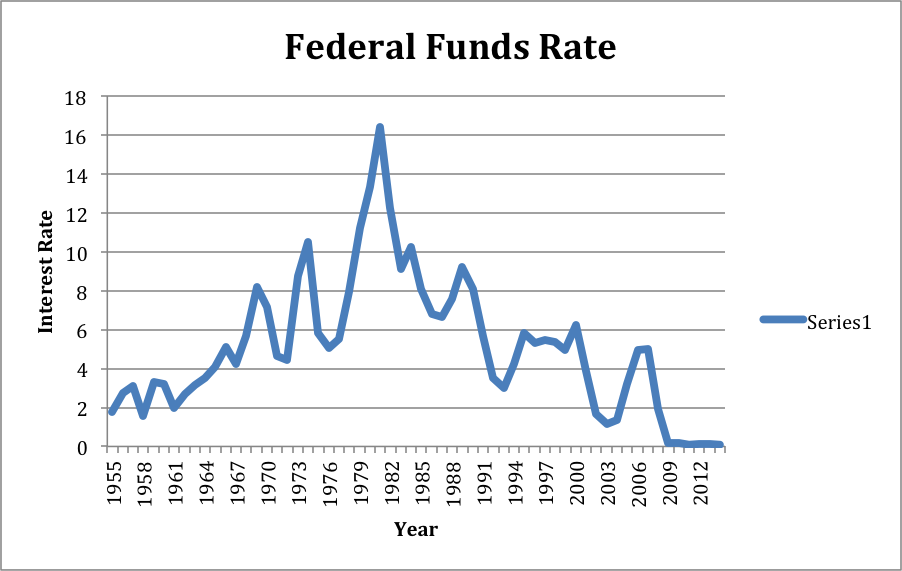
Federal Funds

The federal fund rate is an important indicator of the overall economy. It determines the level of highly regarded institutions rate on the borrowing of money from the Federal Reserve. This rate holds value because it tends to control the rate of interest for borrowers throughout the economy. When this rate rises, banks are forced to raise the interest on their loans in order to combat the price they pay from the Federal Reserve.

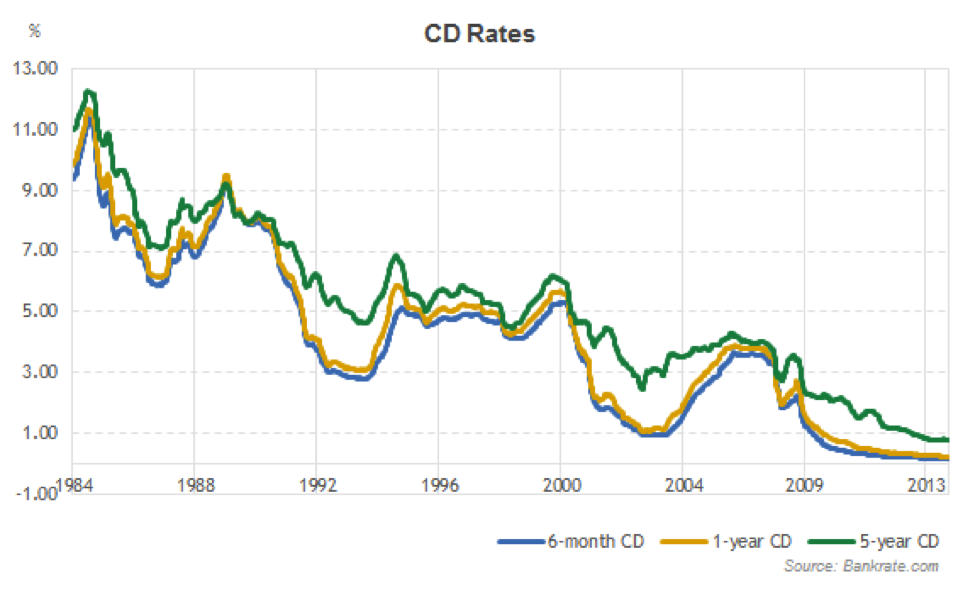
6-month CDs

A 6-month CD is an alternative investment to equities and could bear a higher interest during interest rate rises based on the fact commercial banks will have to pay more to borrow from other banks to compete with the Federal Reserve rate. 6-months may be the horizon for the project (which will be decided based on the planned Federal Reserve’s rate increase) also could be used as a basis or a benchmark depending on whether or not CDs be a leading rate of return.

Currency Fluctuations

The specific currency rate that I will be taking close note of is the euro to the dollar. With interest rates rising, the dollar would appreciate against the euro, which could hurt multi-national corporations in the states.

10-Year Treasury Bill

The 10-year treasury bill are important to economists because it is a large determinant of investor confidence. The 10-year is regarded as one of the safest investment vehicles to invest in throughout the U.S. and perhaps the world markets. Uncertainty in the market could cause a higher demand for treasury notes.

 Inflation Indexed

The inflation index kept track by CPI numbers among other indicators, is an important measure the Federal Reserve will keep track of when raising interest rates. With inflation near 0 a healthier rate is looked at between 1-2%.

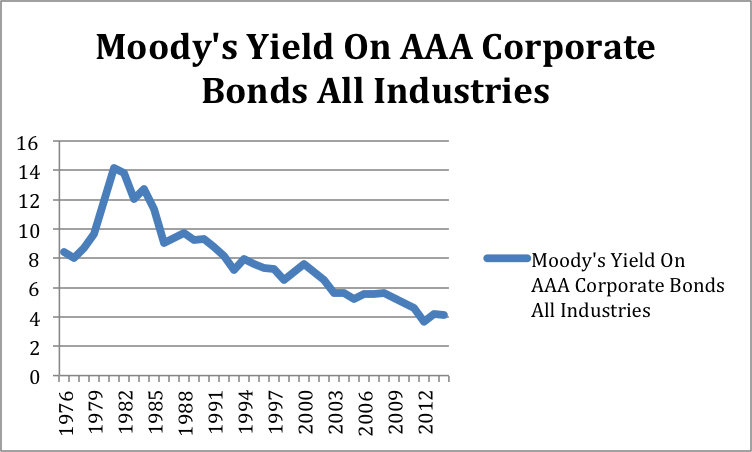
AAA Corporate Bonds

AAA corporate bonds will be a selected condition from Moody’s credit rating service because they are at historically low interest rate. This has created an unusual situation since interest rates and bonds tend to go inversely of each other. Moody’s AAA bond interest rates will be watched as a cautionary measure of corporate bond yields as an alternative investment.

Selected Economic Data

Federal Funds Rate

interest rate pic 1Source federalreserve.org

6-Month CDs

interest rate pic 2 Source: bankrate.com

Currency Fluctuations (Euro-Dollar Exchange)

interest rate 3 Source: federalreserve.org

 10-Year Treasury Yield

interest rate pic 4Source: federalreserve.org

 Inflation Indexed

interest rate pic 5Source: federalreserve.org

AAA Corporate Bonds

 interest rate pic 7Source: federalreserve.org

Equity Screening and Analysis & Reasoning

Based on the selected economic conditions above, as well as fundamental and performance-based analysis, an equity screening and analysis took place.

Sector Specific Screening

Based on the economic conditions that I have selected, along with the Fed’s forecast of a rise in interest rates, the general consensus is investing in financial institutions as the key sector during this economic time. With the raise in interest rates effecting banks, I am filtering equities based on the financial industry. I am not comfortable investing in financial institutions, especially after the financial collapse and the inaccuracy of reports coming from the financial industry makes the screening process increasingly difficult. I chose the financial industry based on the direct impact interest rates have on the industry. Using the selected economic data I found banks benefiting and profiting from a rise in interest rates and therefore an important sector for this project.

Federal Funds Rate

The Federal funds rate is at a historic low. Although the interest rate hike may not be as much of a hike instead of a slight hill, the rate rising still (as discussed in the selected economic conditions section) will cause banks to charge higher interest on their loans. This may (even if a small rise) be a gain for banks. Because of my major precaution against financial institutions with poor financial reports and the 2008 financial crisis, I tried to stay away from banks that hold heavy investments in real estate or mortgage backed securities.

Currency Fluctuations

As previously stated in the selected economic conditions, currency fluctuations affect multinational corporations in the states. So, I can effectively narrow down my search to financial institutions least effected by currency fluctuations. This search would come down to domestic regional banks.

Fundamental Screening

Criteria

-Mid-Large Capitalization

– Trailing PE ratio >20

– Regional Banks

– 0-10% Short Interest

– Net Profit Margin between 10-30%

Holdings

MTB                                                                                        M&T Bank Corporation

BBT                                                                                         BB&T Corporation

CBSH                                                                                       Commerce Bancshares Inc.

PRU                                                                                         Prudential Financial Inc.

RF                                                                                            Regional Financial Corporation

MMC                                                                                       Marsh & McLennan Companies

PFBC                                                                                       Preferred Bank

EWBC                                                                                     East West Bankcorp Inc.

ALL                                                                                          All State Corporation

Exceptions to the Fundamental Screening

PRU

EWBC

ALL

Short Explanation of Screening

I prefer to invest in companies with lower P/E ratios, middle to larger capitalization companies, (although not too large to be effected by currency fluctuations) minimal short interest, and net profit be sustainable to at least 20% and ideally above 25% among other screening criteria.

Prudential Financial Inc.

Prudential is an exception based on its in depth financial reports and value in this equity portfolio. I would consider Prudential as part of the project although it is not a bank; insurances tend to gain in cash flow during interest rate moves. Holding this type of large cap stock also makes its movements within certain ranges more predictable, making its risk lesser compared to mid capitalization companies. It also has a good quarterly earnings growth.

East West Bankcorp Inc.

East West Bankcorp didn’t meet my criteria for net profit margin, but has dividend growth, Schwab A equity rating, and is primarily a regional bank with lending services.

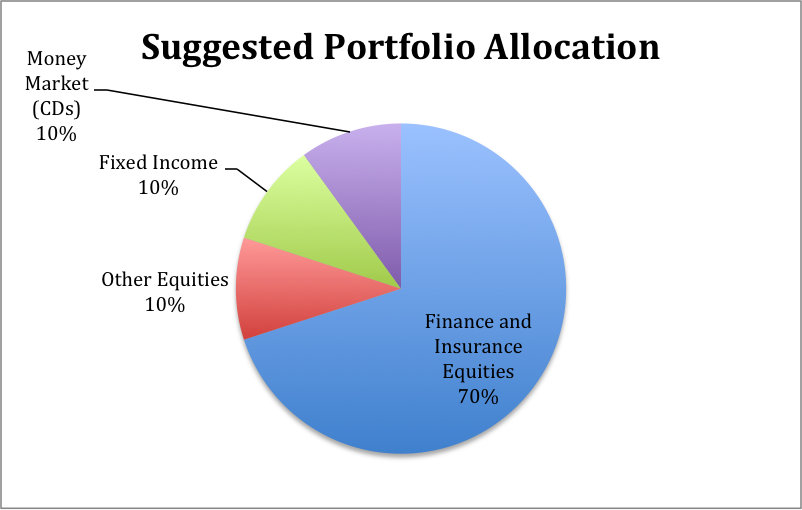
A Suggested Primitive Portfolio Allocation

interest rate 8

Selling Period

I emphasize selling a security being much harder than buying one. The selling period for this project will not be clear-cut until interest rates move upward. Once they do the market reaction and Fed minutes will be reviewed and a selling period will be revised based on the reaction of the markets and the Federal Reserve. A tentative selling period would be 1 quarter after interest rates are raised, also based on each holding’s earnings. Although if economic data still shows financials being a preferred after 1 quarter of interest rate levels rising, a new selling period may be re-examined. This project could be adapt for long-term positioning with appropriate dividend payouts be each company.

Summary

This project will be an ongoing endeavor and will be updated when deemed appropriate. This is an investment project taking into account interest rate levels changing and preparing a portion of an overall portfolio for interest rate levels rising with exposure to equities that may be adapt to a new interest rate level environment. Economic data will be monitored throughout this project from the Federal Reserve, Statistical Abstract of the United States, Board of Governors of the Federal Reserve System, and 2015 FOMC meeting statements and minutes.